How to protect the harbour from the ocean waves?
THE SOLUTION
The breakwaters, massive concrete barriers, codename Phoenix.
These huge structures created calm water within the harbour space, protecting the ships and providing a platform for anti-aircraft guns.
Sixty-five Admiralty blockships, known as Corncobs, were sunk to form the breakwaters known as Gooseberry – but there were insufficient ships large enough to deal with the 40 feet (12m) of water at high tide. The Phoenix caissons, constructed specifically to deal with the Normandy tides, were the engineering solution to this challenge.
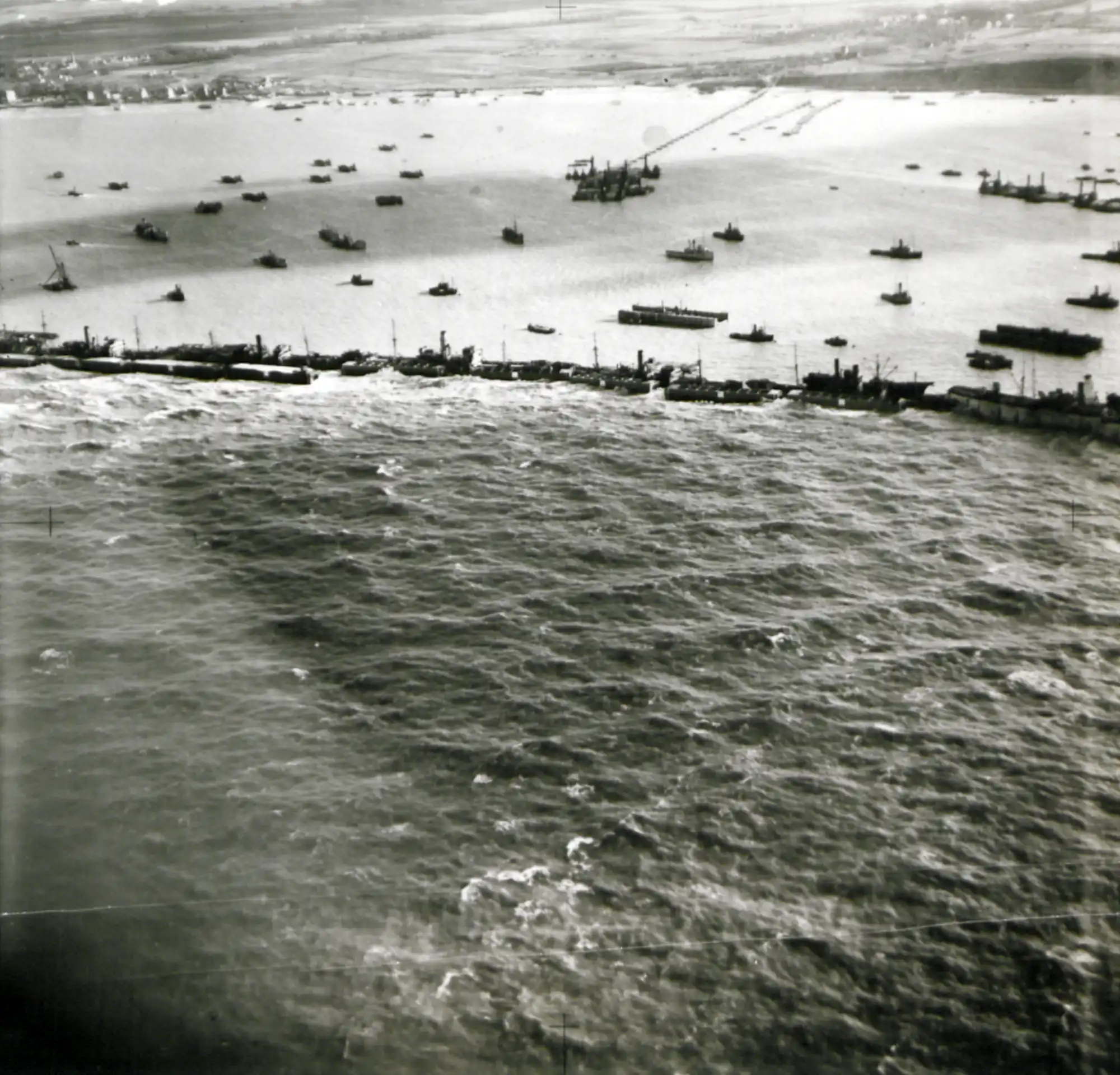
This aerial photograph shows the effect of the breakwaters at the Harbour. REM 10/69. Crown Copyright Open Government Licence 3.0
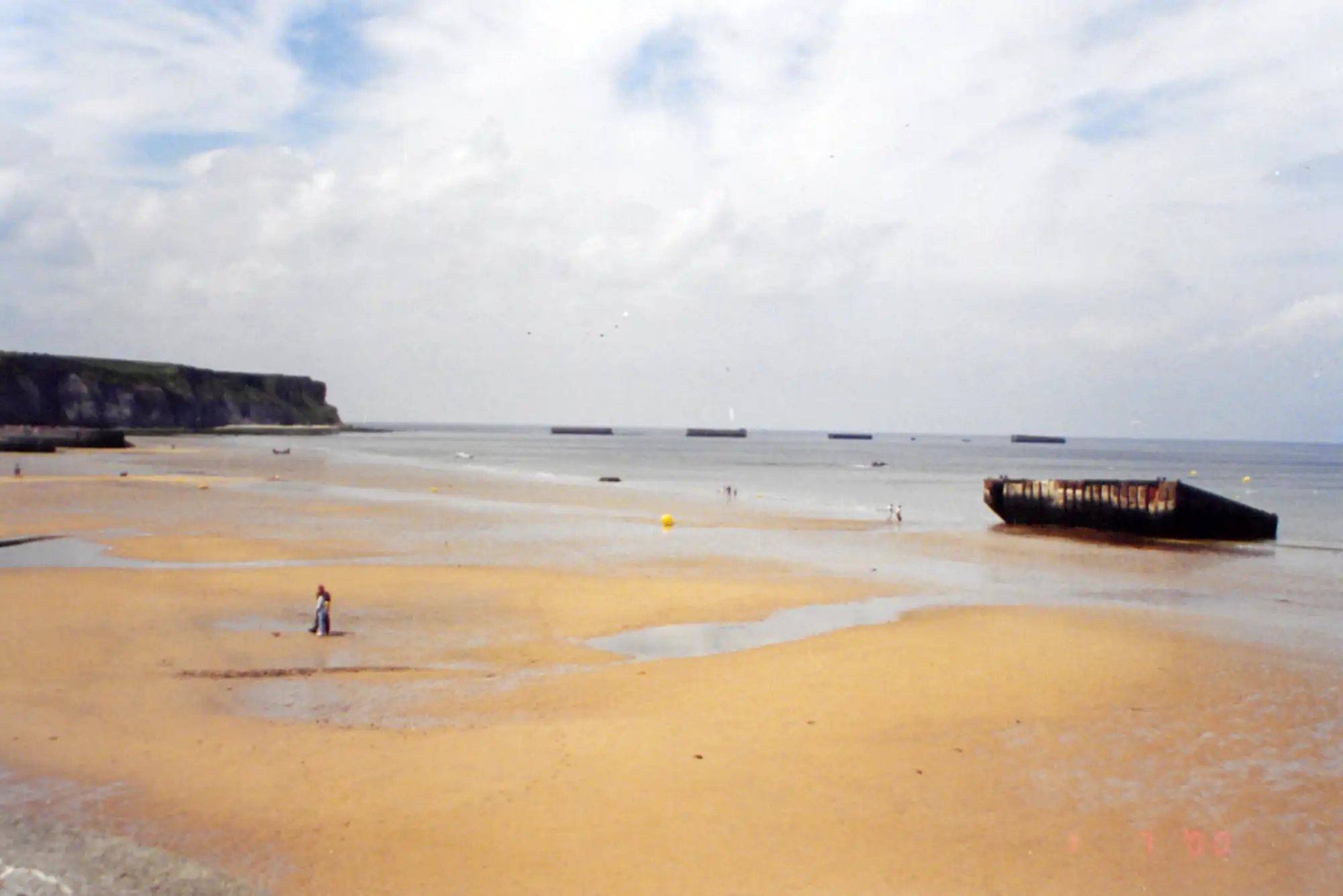
The construction of these concrete giants was not started until 30th October 1943, and yet on 10th June 1944 the first caisson was sunk in place at Arromanches. Still standing over 80 years later, they are a lasting reminder of the engineering accomplishment of the Mulberry Harbours.
The caissons were made in dry docks by pouring cement into enormous wooden moulds, then reinforcing the cement with steel bars. Due to the short time frame for construction, only the base was poured in the dry docks. As soon as it was set, the foundation was floated onto the water to be finished so that construction of the next could begin.

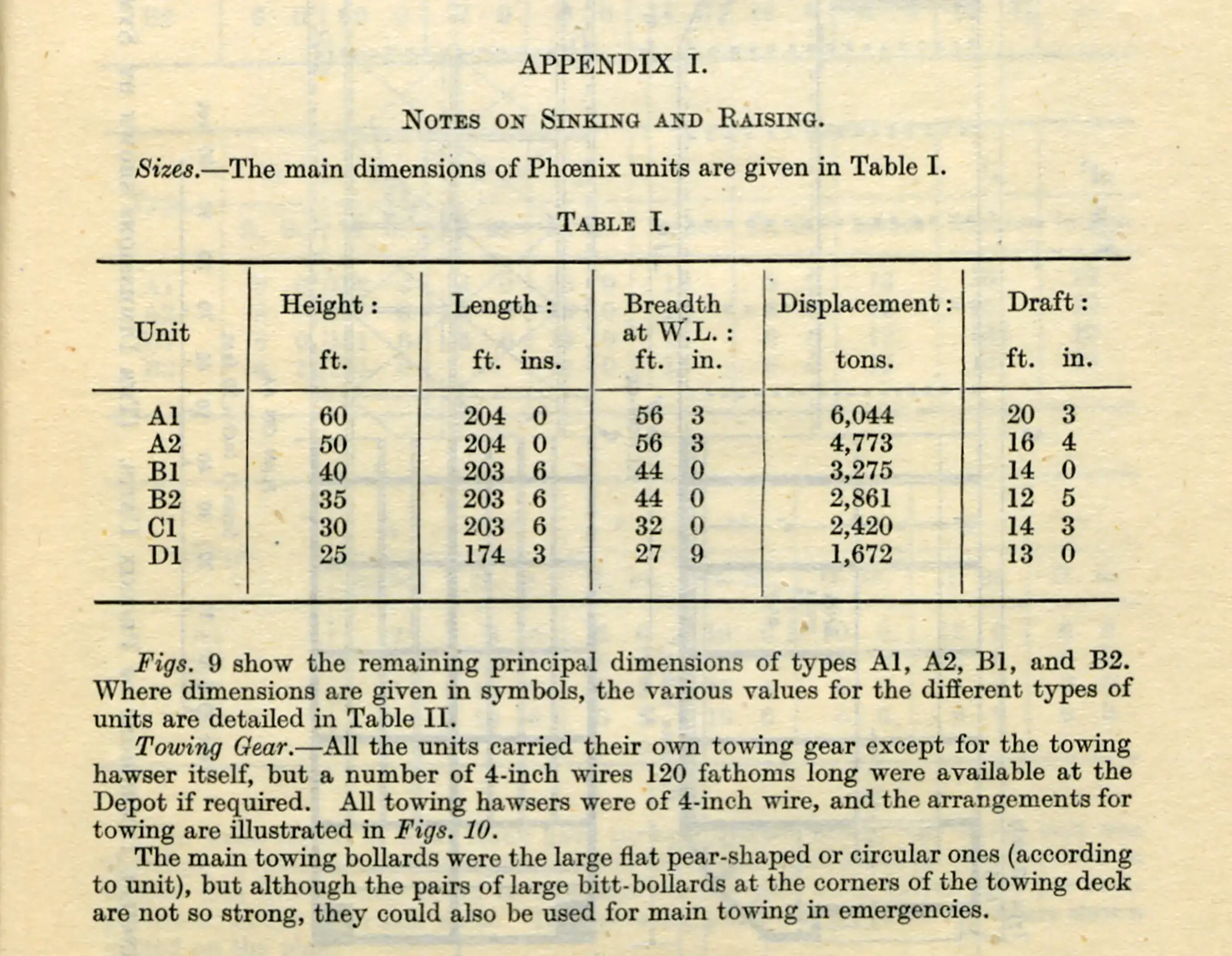
Caissons came in ten varieties, each of varying sizes. This table from a paper, Conference on Wartime Engineering Problems, shows the dimensions of the various sizes of the Phoenix caissons, from A1, the largest, to D1. The A1 sizes made up the majority of the 147 originally ordered for D-Day. REM M1230. Courtesy ICE Library and Archive Service CC BY
The caissons were to be settled on the floor of the sea, and a system of valves and pumps along the bottom of the units allowed them to be sunk and refloated if needed. This ability to ‘resurrect’ the caissons earned them the codename Phoenix.
Deployment
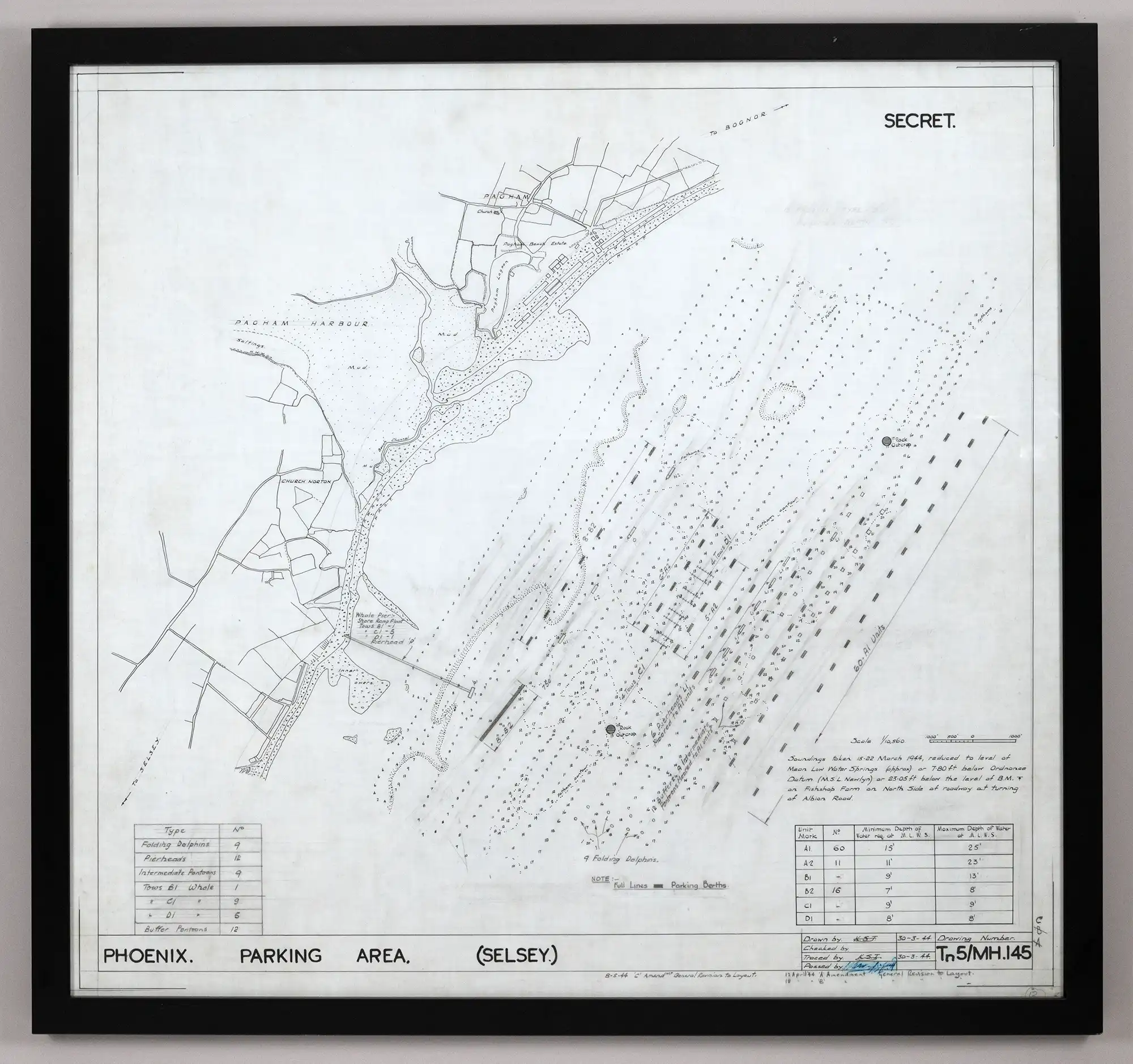
Constructed all around the country, the caissons were towed to Selsey, West Sussex, and Dungeness, Kent, in readiness for D-Day. However, when they arrived, their moorings had been occupied by the Admiralty’s ships. The Sappers had to resort to sinking the caissons off the British coastline to keep them safe from inclement weather and to hide them from German spies.
When the time came to refloat the caissons, pumps were brought in to remove the water. Originally the job of Sappers, the Royal Navy later took over the job of refloating. Eight to 10 units per day had to be refloated to ensure that all units were floating ready for D-Day.
Did You Know:
To ensure their safety, and the secrecy of the D-Day plans, the caissons had been built under such great security that even those workers who spent months building the caissons could not guess that they would eventually be part of an artificial harbour!
![:] A scale model of a B1 caisson, on display in the Museum. 4301.20.9](https://warwinningengineering.co.uk/wp-content/uploads/2026/04/A-scale-model-of-a-B1-caisson-on-display-in-the-Museum.webp)
A scale model of a B1 caisson, on display in the Museum. REM 4301.20.9. CC BY
The Phoenix caissons were not only breakwaters but also provided accommodation for two different crews – a riding crew and a sinking crew. The riding crew accompanied the unit on its journey across the Channel before handing it over to the sinking crew and returning to England to collect their next unit. The sinking crew had the difficult job of sinking the caisson in the right place on the seabed. They also lived onboard, operating the Bofors anti-aircraft guns found on all A1 and B1 units. The caissons not only protected the harbour from the force of the English Channel, but also from the Germans in the air.

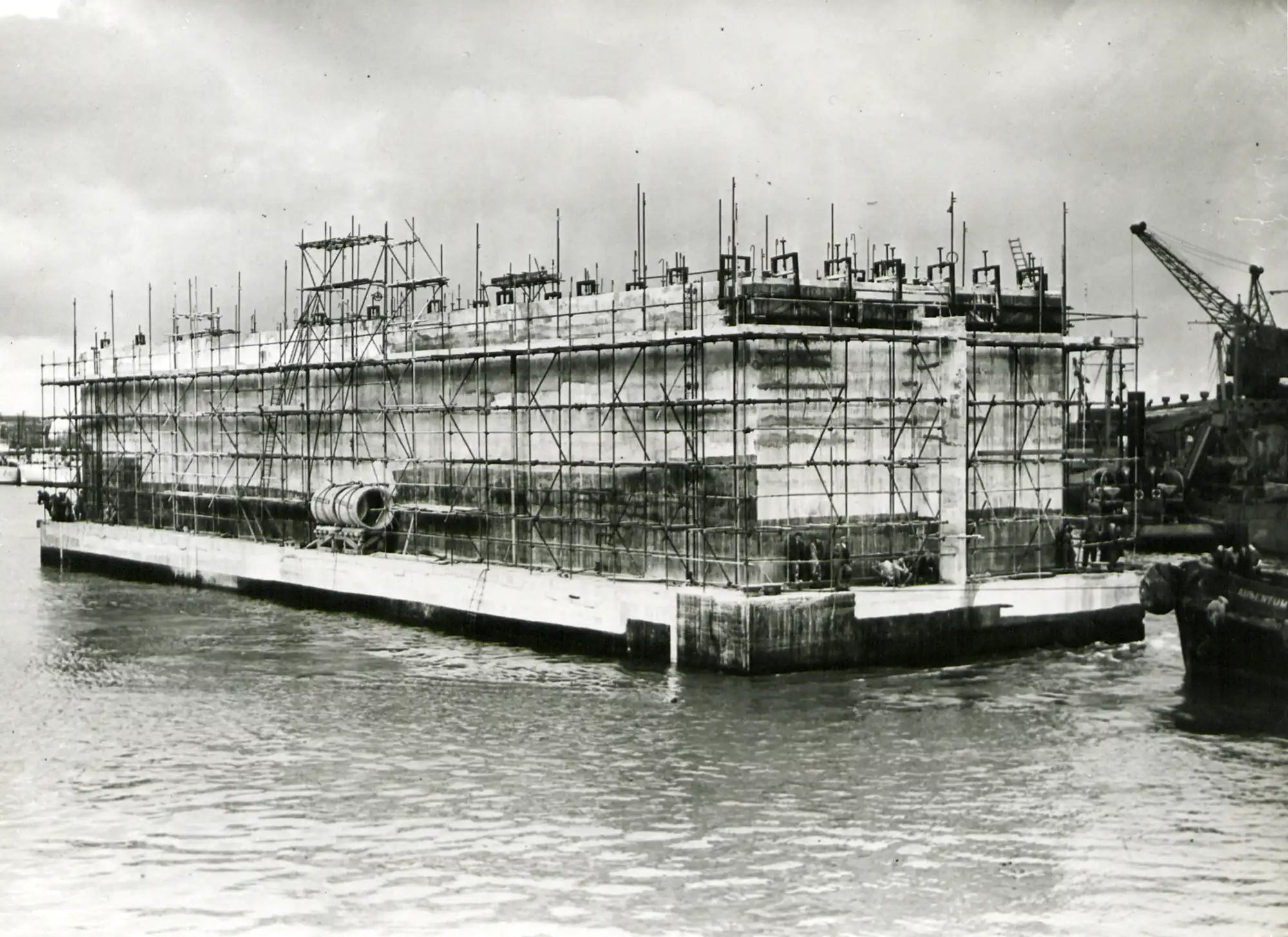
A caisson, floating, but still under construction. The cylinders on the side of the base are the concrete clump anchors. REM 23/891/5/5. Crown Copyright Open Government Licence 3.0
While the Mulberry Harbour was originally intended to last for only 90 days, it operated until the end of November 1944. In fact, this was decided as early as March 1944, before the harbour had even been deployed, when the War Office began preparations for the ‘winterisation’ of the Harbour. For the breakwaters, this involved the creation of 30 AX and 10 BX caissons. These were towed inside the existing line of caissons and provided an extra line of defence against the rough winter seas of the Channel. The main addition to these caissons was a steel roof, which would prevent water going over the top and filling the caisson from the inside. While the units had been designed to withstand the exterior pressure of the ocean, increased interior pressure from water entering during the June storm had caused caissons at both Mulberries to collapse. In addition, steel bars were added between the outer walls and the cross walls of these new caissons to make them sturdier and prolong their life. These caissons still stand at Arromanches today.
How to protect Britain’s coastlines?
THE SOLUTION
Extend the defences into the sea itself.
During the Second World War, Britain was under threat from both the sea and the skies: German U-Boats patrolled the waters, and the Blitz threatened civilians at home. The Maunsell Forts were built in the hopes of combatting this dual threat. Much like the Mulberry Harbours they were built, floated, towed into position, and sunk onto the seabed. They were designed by Guy Maunsell, a civil engineer who had served on the Western Front as a commissioned officer in the Royal Engineers during the First World War.
The Maunsell Army Fort
There were two types of Maunsell Forts – the Maunsell Army Fort and the Maunsell Naval Fort. The Army Forts were placed in both the Thames and Mersey estuaries and were made up of seven individual platforms with concrete pontoon bases joined together by walkways. In the centre of this formation was the control centre, to which all the other platforms were attached. Closely surrounding the control centre were four platforms each carrying a 3.7-inch Quick Fire anti-aircraft gun and one platform carrying a 40mm Bofors anti-aircraft gun. The seventh platform was slightly further away and carried a searchlight. There were three of these forts in the Mersey estuary and three in the Thames estuary, although it was originally suggested that seven forts might be built at the entrance to the Thames. Over the course of the Second World War, the Thames Army Forts shot down twenty-two enemy aircraft and 30 V1 flying bombs known as doodlebugs. The Mersey forts, however, never saw any action.
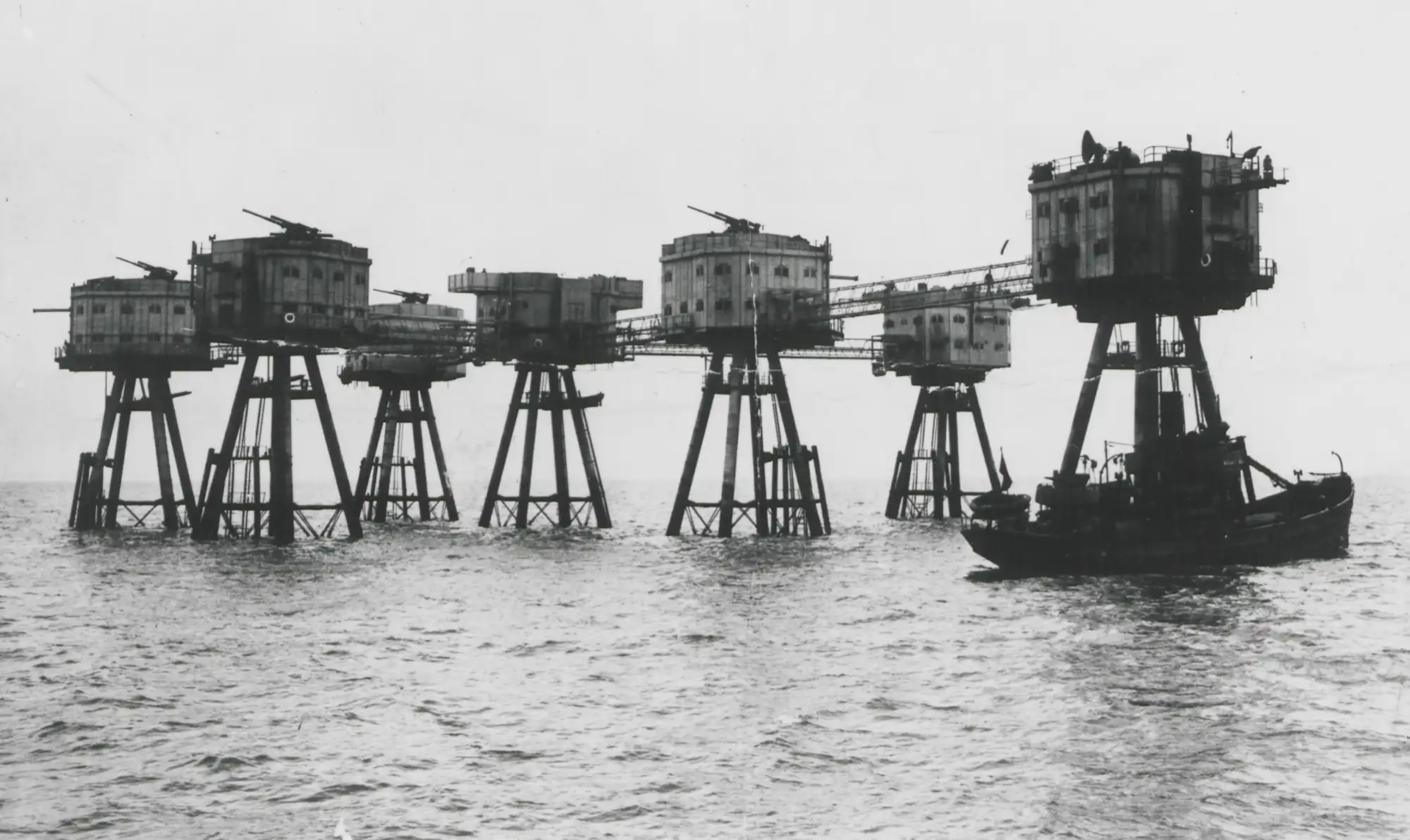
The Shivering Sands Army Fort in the Thames Estuary. The central fort is surrounded by the five anti-aircraft platforms, with the searchlight platform in the foreground on the right of the image. REM 23/235. Fox Photos Ltd. CC BY-NC-SA 4.0
The construction of the Thames Forts was completed in Gravesend by the Holloway Brothers who had been awarded a £724,000 contract (over £28 million today). Like the pierheads and caissons of the Mulberry Harbour, the concrete pontoons at the bottom of the forts were constructed first in a dry dock. Unlike the caissons, the pontoons were shaped like a grid and did not float unsupported. When the base was built, the legs of the fort, which had been precast in reinforced concrete, were added in sections to the pontoon. Finally, the fort, with its supporting platform, was placed on top. The whole structure was then lifted onto two Camel barges and towed into position by at least two tugs. Once in position the concrete pontoon on the bottom of the structure was allowed to sink, and the fort settled into position on the sea floor. The whole fort was around 120 feet (36m) tall, with the legs making up 87 feet (26m) of the height. This meant that at least 30 feet (9m) of the legs would be above the water at all times, protecting the structures and the crew that operated them from the sea. They were installed in the Thames estuary between 20th May and 14th December 1943 - two of the Thames forts remain standing today.
The Maunsell Naval Forts worked in a similar way but looked very different: a single unit, on two concrete towers, sunk onto the sea floor by opening valves on a concrete pontoon base. It took less than five minutes to sink the huge 4500-ton structures. As with the Army Forts, the concrete pontoon was constructed in a dry dock before being floated. The two reinforced concrete towers that the fort rested on were 59 feet (18m) tall and over 22 feet (7m) across, shorter than the Army Forts.
They had seven floors, formed of sections of concrete known as biscuits. Four floors were used to accommodate the 120-strong crew who operated the forts, while the other three contained stores and operating equipment. After launching the first unit, known as Rough Sands Fort or Uncle 1, the engineers realised that they had not considered the problem of re-supplying the crews who lived on board. In seven days, they constructed a wooden dolphin, a landing stage with a crane that could be used to bring supplies aboard. The four units operating in the Thames estuary were sunk between 11thFebruary and 1st August 1942 having only been approved for construction in March 1941, this was a quick turnaround.
Like the Army Forts the four Thames Naval Forts were equipped with QF and Bofors anti-aircraft guns, but the Naval Forts also had radar installed. Their purpose was to deter German air raids from using the Thames as a guide to inland targets, and to prevent German aircraft dropping magnetic mines along the Thames. By 1940 over 100 Navy and merchant ships had been sunk in the Thames estuary by German magnetic mines. Before being launched the Naval forts were degaussed to protect them from this threat. It was the job of the crew to operate the guns and monitor the radar system to prevent further mines being dropped and any German submarines from entering the waters of the Thames estuary. During the war the Naval forts destroyed one German E-Boat.
Did You Know:
Many of the Maunsell forts are still standing today, although Sunk Head Fort was destroyed by 24th Field Squadron RE on 21st August 1967 in response to the trend of pirate radio stations operating out of the abandoned forts.
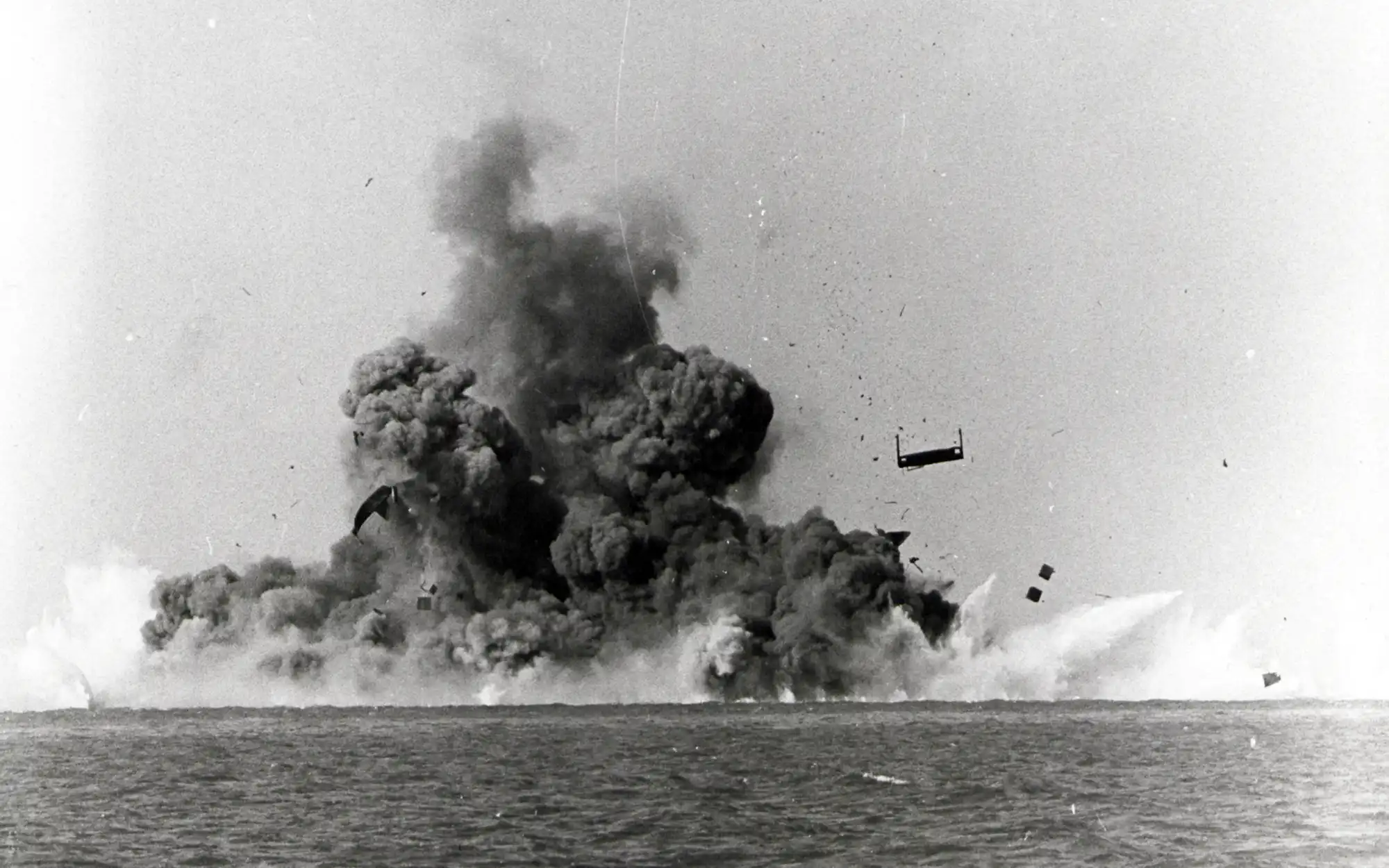
The demolition of the Sunk Head Fort by 24th Field Squadron RE in 1967. REM 23/472. Courtesy of East Anglian Daily CC BY