
How to ensure a safe landing?
THE SOLUTION?
Send a Top Secret group of specialised soldiers to undertake beach reconnaissance.
On New Year’s Eve 1943, Royal Engineers officer Major Logan Scott‑Bowden carried out a covert reconnaissance of Gold Beach. Accompanied by fellow commando Sergeant Bruce Ogden Smith (East Surrey Regiment), Scott-Bowden swam ashore from a landing craft and spent almost two hours surveying the beach near Ver‑sur‑Mer.
Their task was simple but vital: take soil samples to test Gold Beach’s load‑bearing strength and examine the German defences.
Both men belonged to Combined Operations Pilotage Parties (COPP), a small, highly specialised unit that also operated in the Mediterranean and South‑East Asia. Although the men in COPP were predominantly naval, the unit included a key number of Royal Engineers officers and men.
Before any amphibious landing, COPP swimmers would go ashore to gather vital intelligence, such as measuring the beach’s underwater gradients – critical for determining where different-sized landing craft would ground – and checking for uncharted hazards such as rocky reefs that might rip open the fragile hull of a landing craft. On the day of the assault, COPP would guide the landing craft in. Remaining undetected was crucial: discovery would compromise the entire landing.
By late 1943, D‑Day planners were increasingly worried about the possible presence of peat beneath Gold Beach. If a layer of soft peat lay just underneath the sand, heavy vehicles might bog down as soon as they rolled off the landing craft. Combined Operations’ scientific adviser, J. D. Bernal, carried out extensive research in libraries and confirmed that the Romans had once cut peat here for fuel. With centuries of subsequent coastal erosion, planners feared those ancient peat beds might now lie directly under the modern beach.
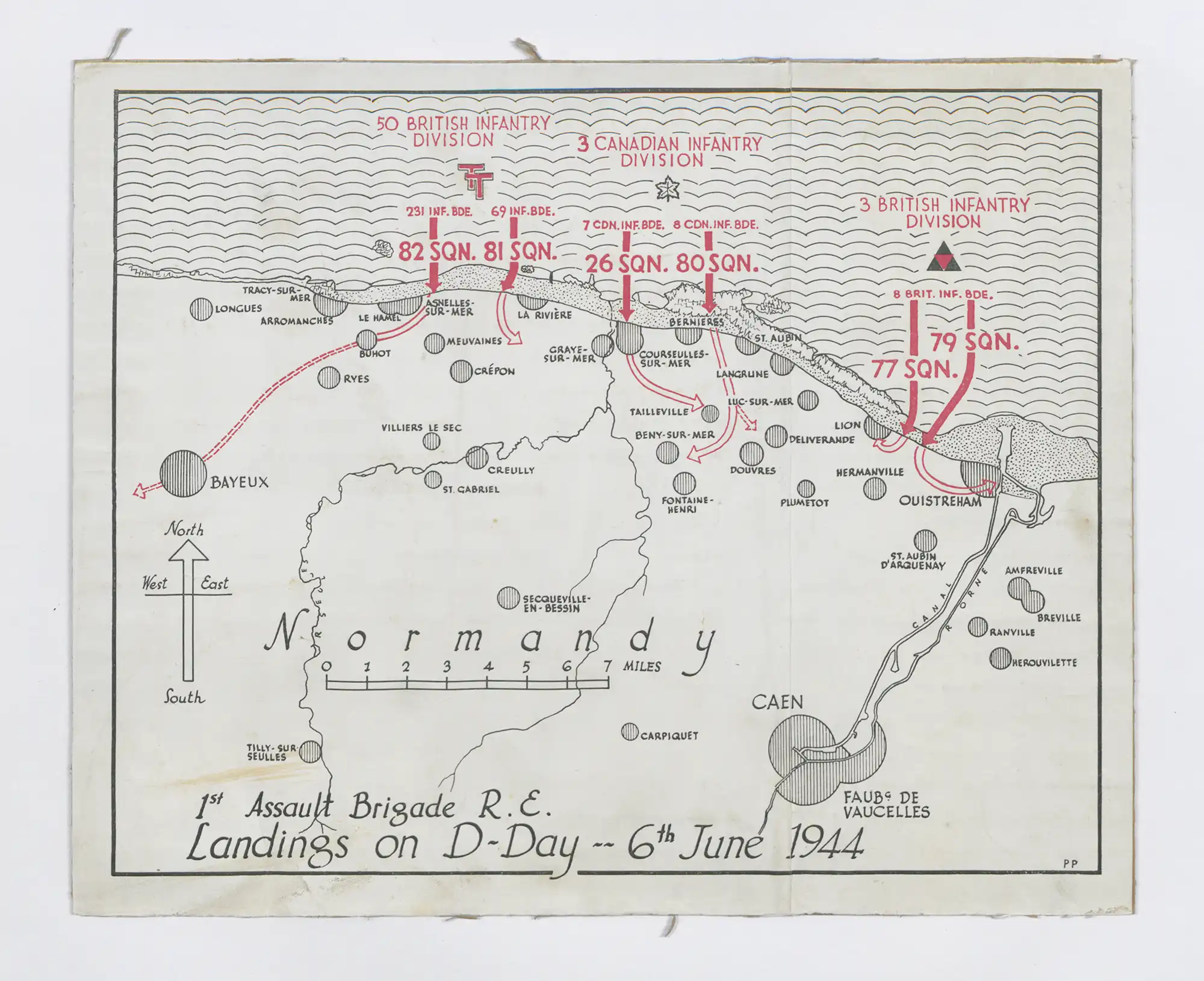
A map of the Landings on D-Day by 1st Assault Brigade, showing Divisional areas of landing. REM 5911.8. Crown Copyright Open Government Licence 3.0
To test the risk, experiments were run on Brancaster Beach in Norfolk, whose geology closely matched Gold Beach’s. The experiments team included Major Fred Shotton, 21 Army Group’s Royal Engineers geologist. Their conclusion was stark: to support the heaviest vehicles, at least 12 inches of sand was needed above any peat layer. The stretch of beach at Ver‑sur‑Mer was flagged as the most concerning. Scott‑Bowden and Ogden Smith were ordered to investigate.
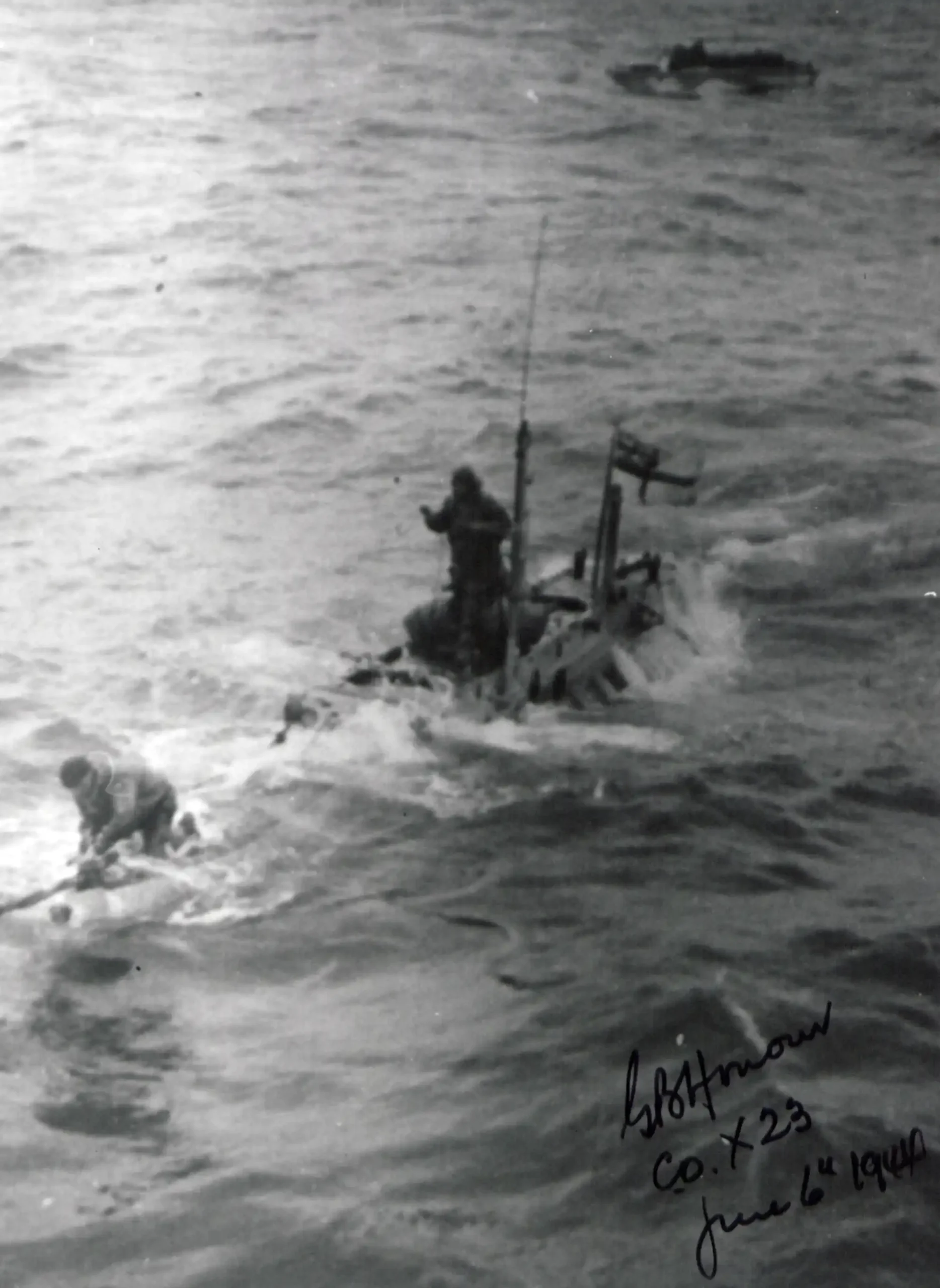
Their reconnaissance was originally meant to be carried out by swimming ashore from an X-craft midget submarine, but at the last moment the plan shifted to an LCP(L) landing craft that had been adapted for shallow‑water hydrographic survey work.
Eventually, once in the designated area, they began their methodical ‘W’‑pattern survey. Each man took ten soil samples using a 12‑inch auger, transferring each plug of sand into a tube, sealing it, and stowing it in a bandolier worn by the other. As they worked, they heard doors opening and closing in huts just beyond the beach. Twice they saw torchlight, and at one point Ogden Smith thought he saw movement in the grass bank.
By 00:30 on New Year’s Day, the reconnaissance was complete. Laden with equipment and heavy with sand samples, they struggled to fight their way back through the surf. Only on their third attempt did they manage to punch through the breakers, which had grown steadily worse with the weather.
Halfway back to the landing craft, Scott‑Bowden heard Ogden Smith shouting. Fearing trouble, he turned and swam back – only to discover that Ogden Smith was wishing him a happy new year. ‘Swim, you bastard, or we will be back on the beach’, Scott‑Bowden growled, before relenting and wishing Ogden Smith a happy new year, too.
A quarter of an hour later, exhausted and half-frozen, they were hauled back aboard the landing craft and began the long journey home.
Analysis of their samples confirmed the planners’ fears: parts of Gold Beach were indeed suspect. But with key D‑Day objectives – such as the Mont Fleury battery and the Bayeux–Caen road – lying just inland, landings had to go ahead in this area. Beach parties were briefed on how to mitigate the risks, for example by cutting a small gap in the clay ‘lip’ of any shell crater so it filled again with sand at the next high tide.
Landing Craft Tank assigned to this area were fitted with ‘roly‑poly’ beach matting on their bow, ready to be unrolled by the first tank ashore to create a firmer track across the sand. (In the event, the rough seas on D-Day meant this matting wasn’t a success.)
Scott‑Bowden and Ogden Smith returned to Normandy in mid-January 1944 when they reconnoitred Omaha Beach from midget submarine X‑20. This time the focus was less on geology – Omaha’s load‑bearing capacity was far less concerning – and more on charting the German defences that were rapidly taking shape along the bluffs.

A detail from a First Day Cover commemorating the first X Craft across the Channel on D-Day. The cover was produced for the 40th anniversary of D-Day in 1984. REM 8804.15.2. CC BY-NC-SA 4.0
For his reconnaissance of Gold Beach, Scott‑Bowden received the Military Cross. He retired from the Army in 1974 as a Major‑General and later served five years as the Royal Engineers’ Colonel‑Commandant. He died in 2014, aged 93.
By Rob Crane