
How to keep the vehicles running past the beachhead?
THE SOLUTION?
Operation Pluto – Pipe-Line Underwater Transportation of Oil, more commonly known as Pipe-Line Under The Ocean, a pipeline for fuel running under the Channel.
These pipelines were intended to deliver the huge quantities of fuel needed for the invasion safely to the Allied operations in France.
‘Could you run a pipeline under the Channel to supply oil when we invade?’ Lord Louis Mountbatten asked in April 1942. The answer, in the form of the PLUTO pipelines, was yes. Carrying 820 million litres of petrol in their one-year lifetime, the pipelines supplied oil to fuel the Allied armies as they advanced across Europe.

A commemorative spanner presented to Sir Thomas Riddell Webster, Quartermaster General to the Forces, upon the final connection of the PLUTO pipeline in April 1945. It is now held by the Museum. REM 6502.8.2. CC BY
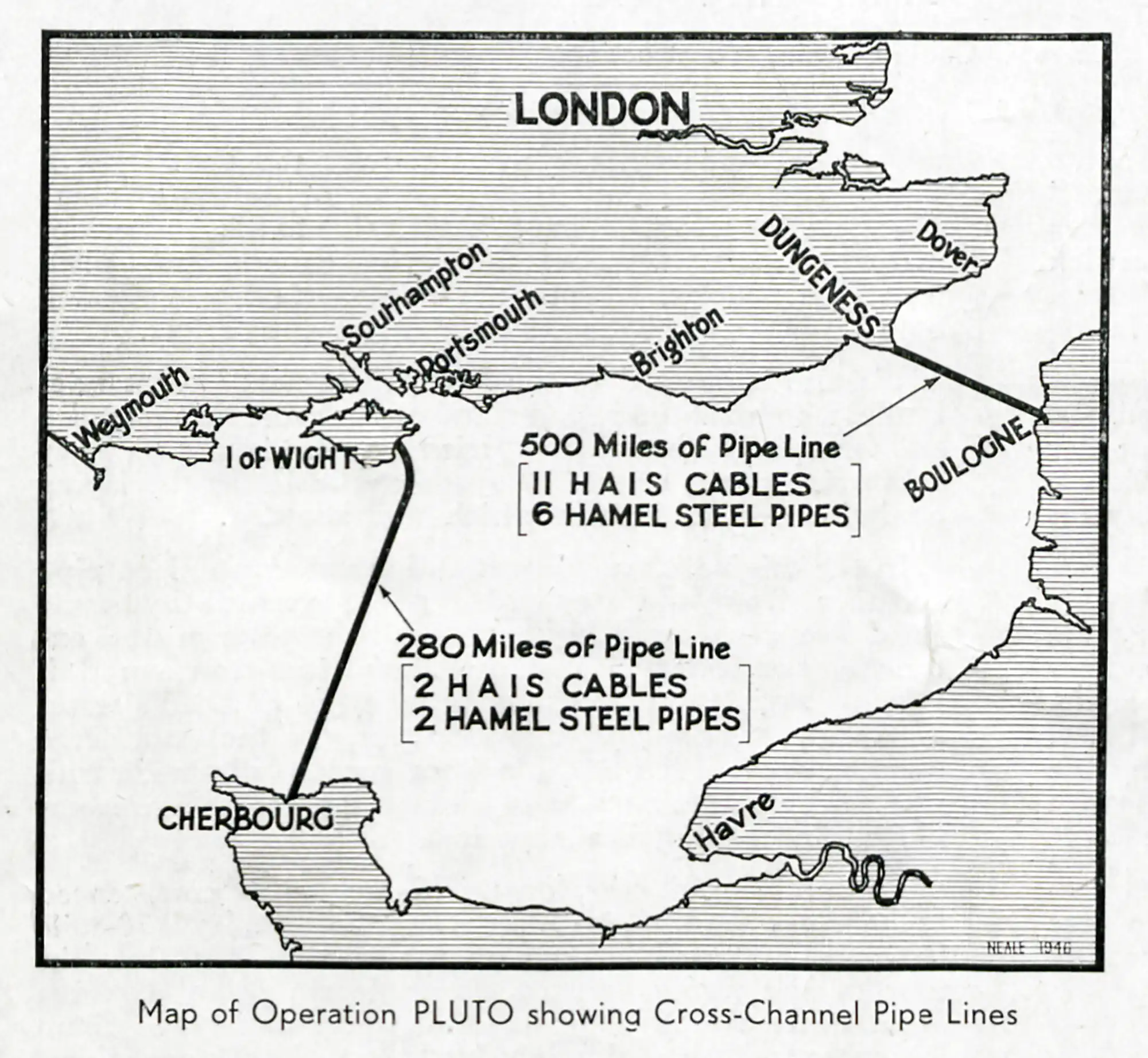
Operation PLUTO consisted of two pipeline routes. The first ran from the Isle of Wight to Port-en-Bessin, which lay between the Omaha and Gold invasion beaches; the second ran from Dungeness to Boulogne. The routes were called Bambi and Dumbo.
Two pipe designs were used, known as Hais and Hamel. Two Hais and two Hamel pipelines ran along the Bambi route, while 11 Hais and six Hamel pipelines ran along the Dumbo route.
Hais
Named after its inventor, Clifford Hartley, and the companies involved, The Anglo-Iranian Oil Company, and Siemens, the Hais pipeline was made up of several layers. The inner pipe was made from extruded lead wrapped in a layer of asphalt, then a layer of paper impregnated with resin, layers of steel tape, a layer of jute tape, a layer of asphalt impregnated paper, steel wires, and finally a camouflaged canvas cover.
A section of Hais pipeline displayed in the Museum, showing the many layers. REM 6502.2. CC BY
The design was trialled in the River Medway in May 1942, laid from Chatham by a Post Office cable ship. After the pipe burst in testing, the number of layers of steel tape were increased from two to four. The Hais pipeline originally had an internal diameter of two inches (5cm), but this was upgraded to three inches (7cm) in autumn 1943 to increase the capacity. Each mile of Hais pipe used 24 tons of lead, 7.5 tons of steel tape, and 15 tons of steel armoured wire. With over 800 miles of Hais pipeline produced, this was a huge amount of wartime resources, and after the war there was an effort to salvage the pipes from the bottom of the Channel, with 23,000 tons of lead recovered.
Hamel
The Hamel pipeline was also named after its inventors, HA Hamel and BJ Ellis. In contrast to the Hais, the Hamel pipe was made from mild steel with walls just 5.4mm thick. This thinner construction meant that it could not be transported as the Hais pipeline was – wound flat in the floor of a ship – but was wound instead around a Conundrum. A Conundrum was a giant spool, with a diameter of 39 feet (12m), that could carry up to 90 miles of the pipeline. This was slowly paid out into the ocean from a ship. HMS Persephone was used in trials: a fitting name, as Persephone was the wife of Pluto in Roman mythology.

A vast, beached, Conundrum with a few lengths of Hamel pipeline wrapped around it. REM 6/21. Crown Copyright Open Government Licence 3.0
The rolled method of laying meant that the sections of Hamel pipeline had to be welded rather than bolted together for extra structural integrity. It was decided that they would be flash welded, where both ends of the pipe were heated and then fused together. This technique was faster, required less skill and fewer materials. However, it did create excess metal on the inside of the pipe, known as inside flash, which had to be removed by a specially developed broaching tool which could reach inside the 40-foot (12m) section of pipe and sand away the excess metal.
Hamel pipelines were expected to last for only 6 weeks – enough to provide the time for the Allies to establish a bridgehead and capture a port with oil facilities.
PLUTO
As with many wartime activities, the PLUTO project was surrounded by secrecy. Anyone involved in the project was encouraged to refer to the Hais and Hamel pipes as ‘cables’ to misdirect German spies. In addition, the pumping stations on the Isle of Wight and at Dungeness were disguised in ordinary looking buildings, as bungalows and even an ice cream shop. Drivers making deliveries were not given exact directions but instructed to call from a phone box nearby to receive the address verbally.
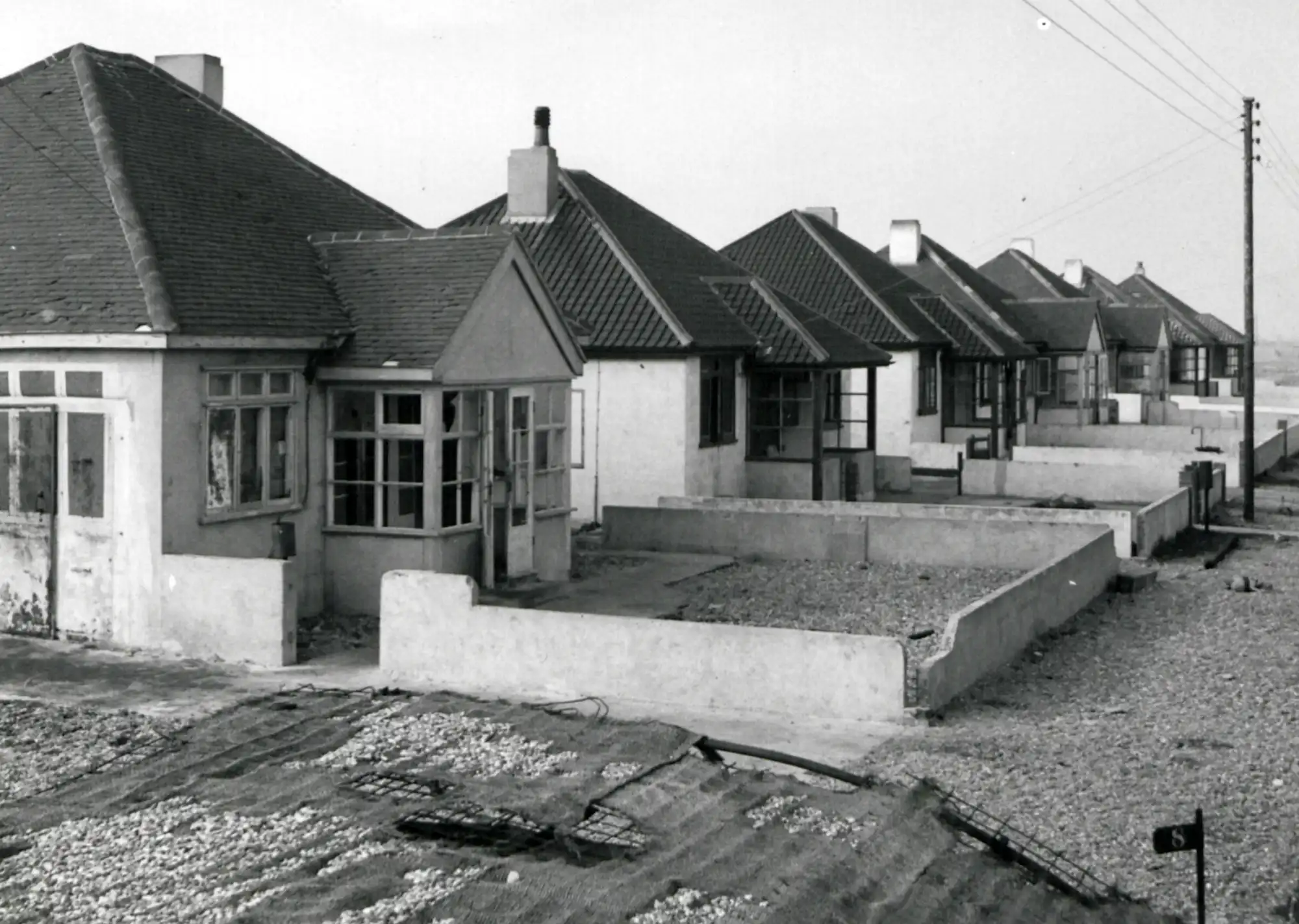
A line of bungalows at Dungeness used as pumping stations for Operation PLUTO. REM 6/21. Crown Copyright Open Government Licence 3.0
Although the huge Conundrums used for the Hamel pipeline were not disguised, they were unlike anything that had been made before and were not attacked by the Germans.
This secrecy, as well as the innovative engineering, helped PLUTO to succeed.
Bambi was only operational for 12 days between September and October 1944, but Dumbo was in use until July 1945, by which time it had been brought inland as far as Emmerich by the Royal Engineers. By the end of the war PLUTO was delivering 3500 tons of petrol a day – more than half of the British requirement. The scheme was described by General Eisenhower as ‘second only in daring to the artificial harbours’.
Did You Know:
A map showing the Dumbo and Bambi PLUTO pipelines laid across the English Channel from the January 1946 Engineering Bulletin. REM M1154. E A Beavis CC BY-NC-SA 4.0
How to efficiently transport fuel beyond the PLUTO pipelines?
The solution? Look to the enemy’s solutions and innovate.
Transporting fuel safely and efficiently was one of the key challenges of the Second World War. At the outbreak of the War, the British Army were using flimsies – carriers made of tin that could carry 18 litres of fuel. These tins could also be converted into a Benghazi Burner, or makeshift stove, by puncturing the top and filling the bottom with fuel and sand before igniting. However, the flimsies were easily broken and hard to carry. It is estimated that the British lost about 25% of their fuel through broken flimsies, especially aggravated when vehicles were crossing over the uneven terrain of the desert in Northern Africa. These fuel leakages could even cause the vehicles carrying the containers to explode, losing both valuable fuel, vehicles, and men.
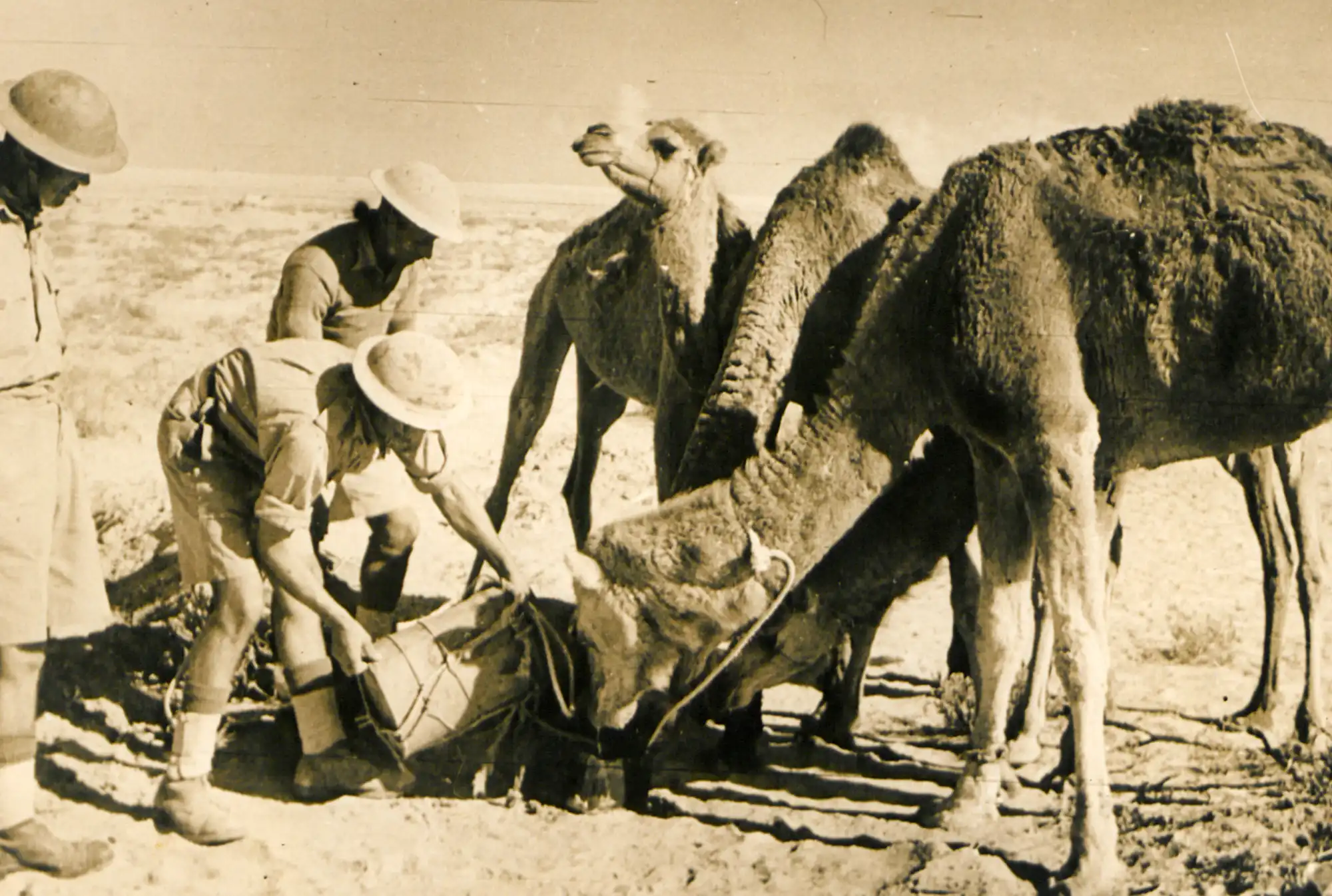
Soldiers water a camel in North Africa using a tin container. REM 23/556. Crown Copyright Open Government Licence 3.0
While lots of different fuel-carrying methods existed, the British addressed this problem through the adoption of the jerrycan. Reverse engineered from a German design, the jerrycan solved the issue of transporting fuel across Europe and beyond.
Designed by the Germans in 1937 and known as Wehrmacht-Einheitskanister or Armed Forces Standard Cannister, the jerrycan could hold up to 20 litres. It had three handles along the top so that a single soldier could carry two full cans or four empty cans. It could also be passed down a line of men with ease.
Another key feature were the indentations on the sides of the cans –the liquid inside could expand and contract without causing the can to burst, making the jerrycan less prone to breaking if dropped.

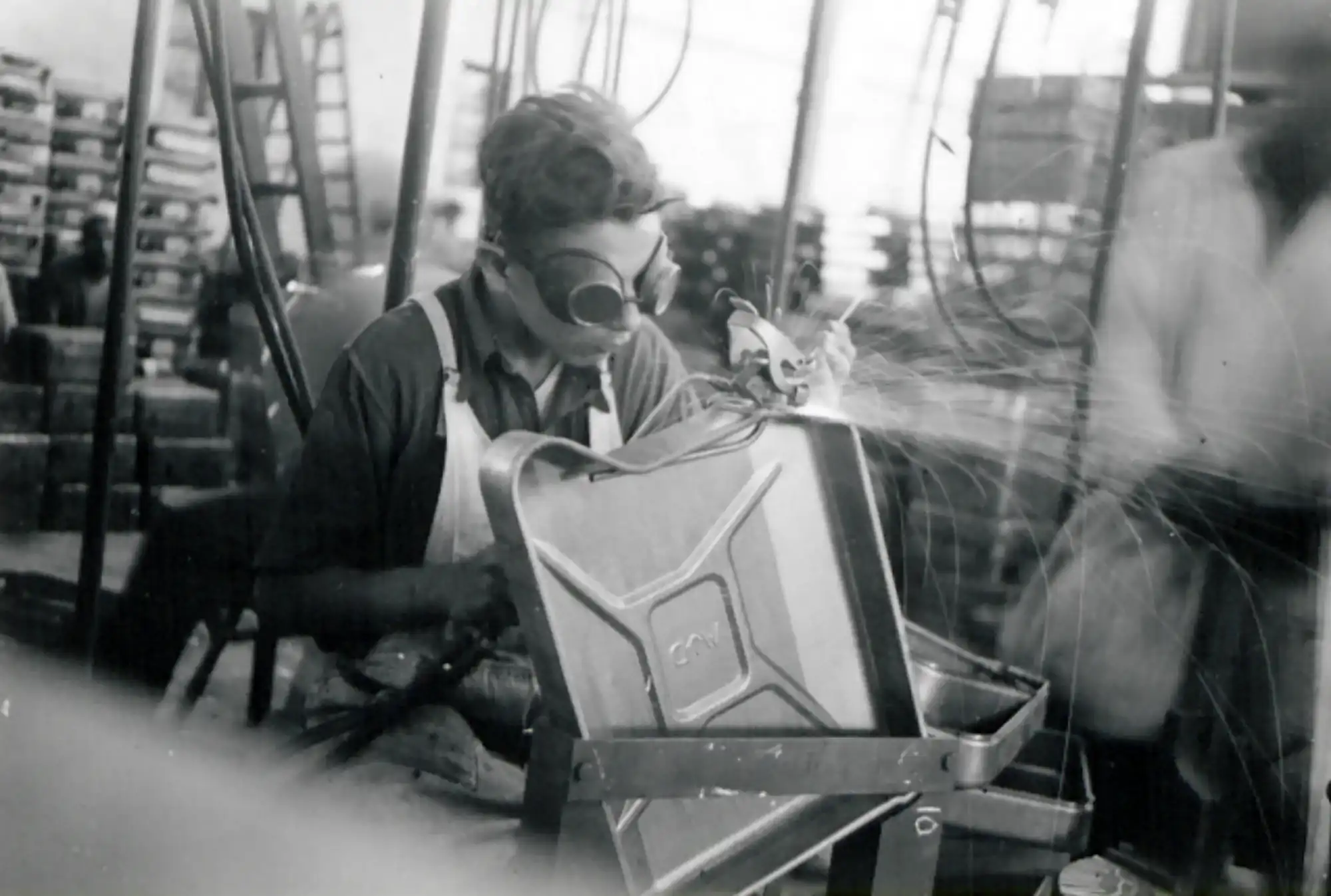
A jerrycan being welded in a factory in Egypt. REM 23/258. CC BY-NC-SA 4.0
Made of pressed steel, they were constructed by welding the two halves of the can together, forming a complete unit. While the flimsies required a wrench to open them and funnel to pour liquid out of them, the jerrycan had a lever release mechanism to open and a short spout with airpipe for smooth pouring. Soldiers did not need to carry anything extra, and less fuel was lost during pouring.
An air pocket under the handles of the jerrycan allowed for fuel expansion and provided buoyancy. The jerrycan could be dropped into the sea and would float until it was picked up. Coloured and stamped tags indicated the contents of a jerrycan, which could be filled with fuel, oil, or even water, and still be told apart. The different shapes stamped on the tags allowed this to be done in the dark or under a smoke screen.
Did You Know:

President Roosevelt described the role of the jerrycan in the Allied victory: ‘Without these cans it would have been impossible for our armies to cut their way across France at a lightning pace which exceeded the German Blitz of 1940’.
The jerrycan is an iconic piece of Second World War engineering that is still in use today, albeit made of plastic rather than metal, but showing just how effective it was at fuel transportation.