
How to keep the roadways afloat?
THE SOLUTION?
Simple, unsinkable pontoons, codename Beetle.
Development
Around 500 Beetle pontoons were constructed for the two Mulberry Harbours. They were a relatively simple idea: a float to support the roadways. Officially called Pier Pontoons, they were known as PP or Beetles. Unlike most of the Mulberry codenames which had no physical link to the elements they described, the Beetles were named after their shape, although the design may actually have been inspired by a turtle’s shell.
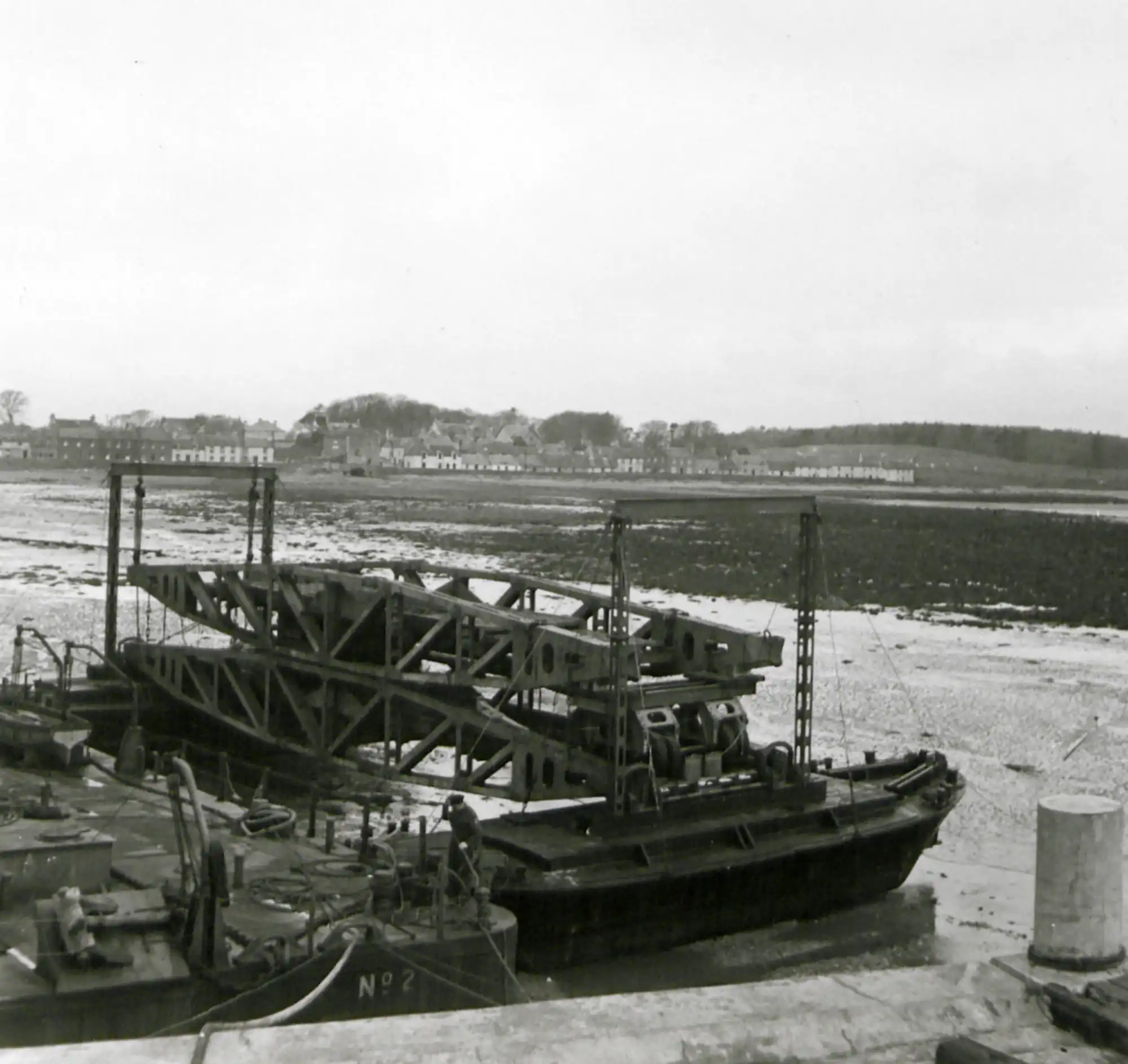
The Beetles came in all sorts of shapes, sizes, and materials, with seven iterations in total, known as PP1 through to PP7. The first two versions, PP1 and PP2, looked like small boats. They were 50 feet long and 22 feet wide (15m x 6m) and were made up of ten watertight components. While they kept the Whale roadways afloat, they were unstable and prone to pitching in bad weather, making them unsuitable for the rough Channel waters. They also proved difficult to transport across the Channel and created too much resistance while towing. It was back to the drawing board.
PP3 and PP4 were both prototypes that were never used. PP3 was a reinforced concrete erection tank that was never built. PP4 was the first recognisable Beetle but was only ever used for experimental purposes. Unlike most of the Mulberry Harbour components there was a lot of trial and error in the design and manufacture of the Beetle pontoons.

55 tons = 13 hippopotamuses

PP5 and PP6 – 41 feet 9 inches long, and 15 feet and 3 inches wide (13m x 4m) - were designed to work with the Mark I Whale roadways which could carry 25 tons. PP7 was even bigger at 41 feet and 9 inches long and 18 feet and 9 inches wide (13m x 5m) and designed to work with the Mark II roadways which could carry 40 tons.
Construction

A scale model of a Spudded beetle, on display in the Museum. REM 4301.20.18. CC BY
Although the Beetles were originally intended to be constructed from steel which was 3/16 of an inch thick (0.5cm), only 200 could be made this way due to the shortage of steel in wartime Britain. These steel pontoons were reserved for the shore ends of the roadways where there were rocky outcrops which might damage Beetles made from other materials. To deal with this difficult terrain, some of the steel Beetles had Spud legs like the pierhead pontoons. These were operated by a hand winch and raised the Beetles so they would not be damaged while Sappers removed the rocks underneath using compressed air tools. Once the ground was cleared, the pier pontoons could rest on sandbags.

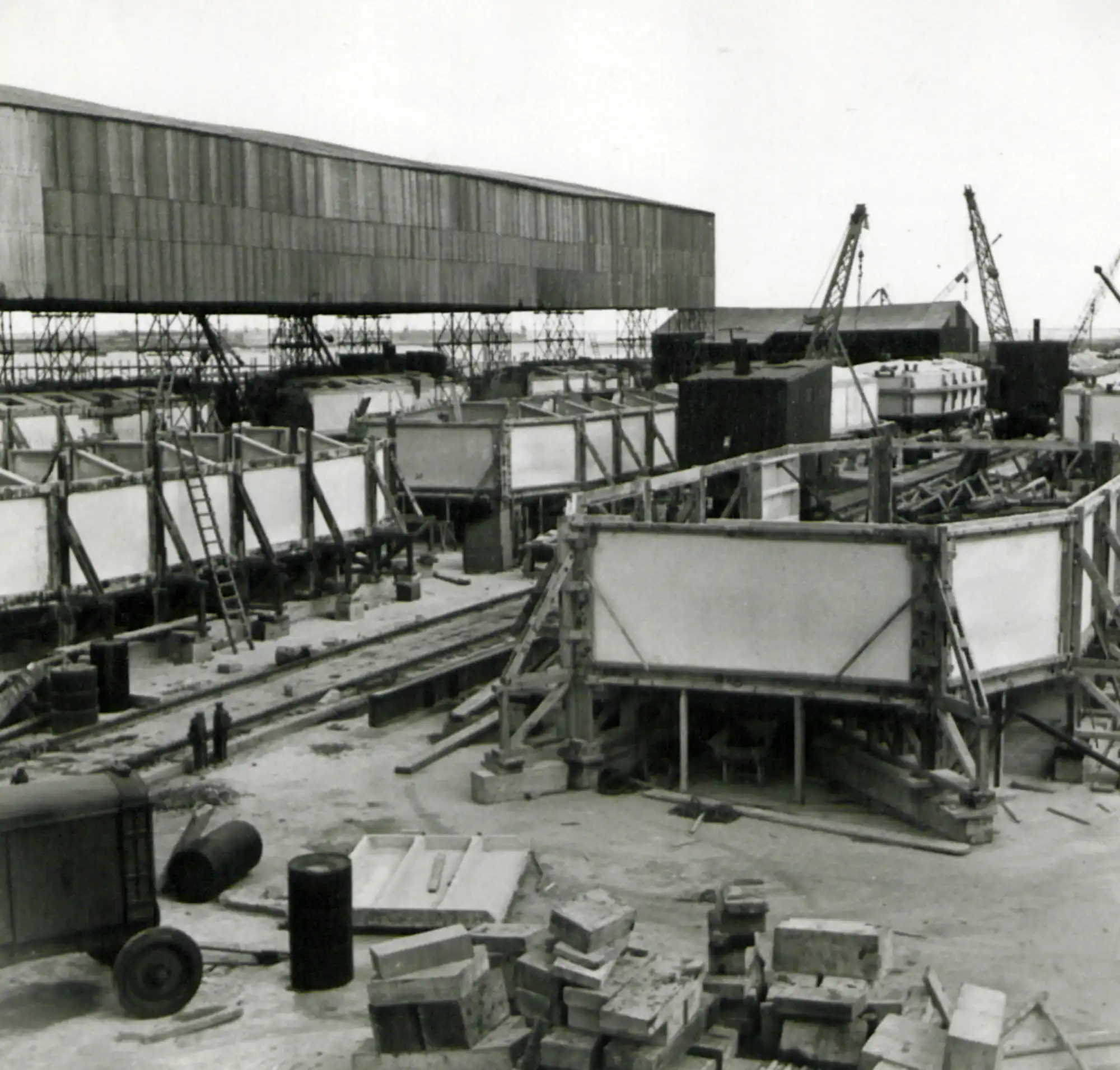
The Beetles were essentially hollow floating shells. This image shows several concrete Beetle pontoons under construction. REM 23/45/29. Crown Copyright Open Government Licence 3.0
Each concrete Beetle pontoon was made up of 65 panels connected together. Thirty-six different types of mould were needed to construct the 1 ¼ inch (3cm) panels for each pontoon. The concrete was prone to damage from enemy fire and rough conditions. In the event of damage to the shell, an inflatable rubber Camel float could be inserted into the hole and filled with up to 12lbs (5kg) of air. This allowed the pontoon to be kept afloat under enemy fire until it could be fixed by Sappers once the coast was clear.
Did You Know:
The Beetle pontoon, with its many iterations, shows how war winning engineering relied upon testing in trials to overcome numerous practical challenges, as well as innovative solutions to major problems.
How to stop the Beetles drifting?
The solution: a lightweight but strong anchor, known as the kite anchor.
The anchors had to hold a pulling weight of 30 tons, keeping the beetle pontoons firm against the tides and weather, but still needed to be light enough to be laid from a small boat.
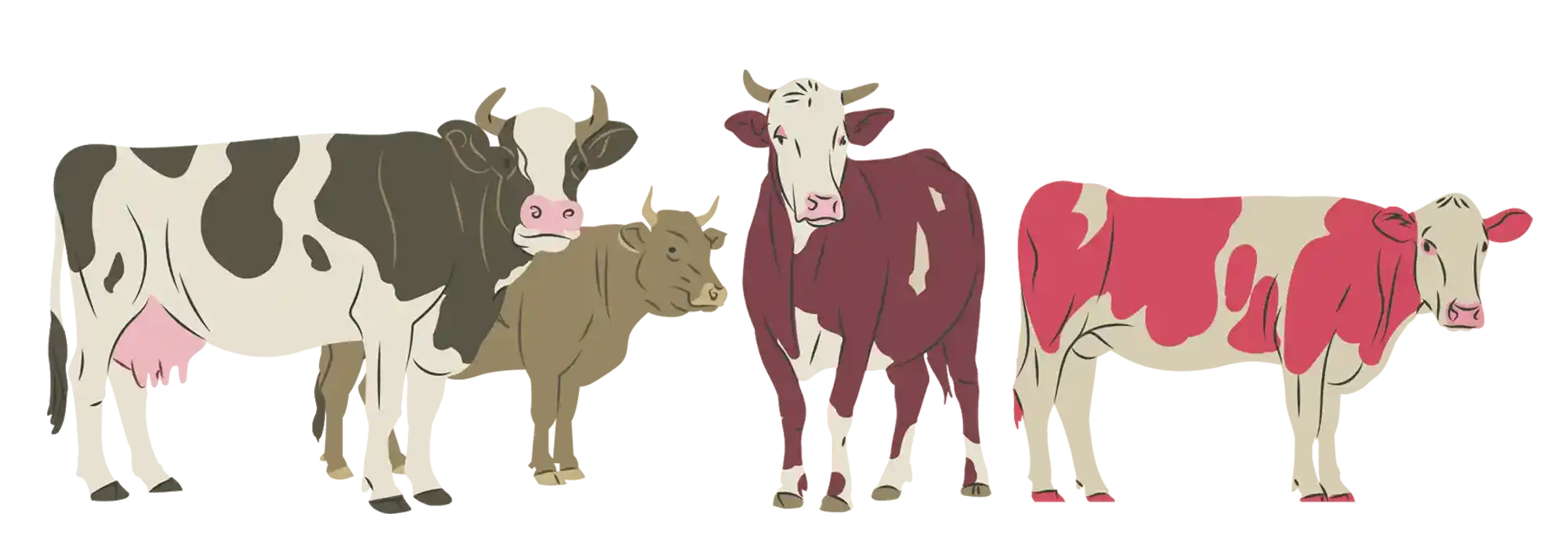
The Kite Anchor was designed by Allan Beckett, a civil engineer who enlisted in the Royal Engineers in 1940 and who was responsible for the design of the Whale roadways. It had three key features: it was self-righting, self-burying, and incredibly strong. It was 11 feet and 6 inches long (3.5m) and made of mild steel. Weighing just three tons, it could resist a pull of 30 tons.
3 tons = 4 cows
This relatively lightweight anchor used the same forces as those that operate on a kite, except downwards instead of up. Unlike a standard admiralty pattern anchor, which relied upon weight alone to stop motion, the Kite Anchor buried itself into the soft ground below, continuing to sink until it reached hard ground. The more the pontoon that it was attached to moved, the more it drove the Kite Anchor down into the seabed. Some Kite Anchors travelled 30 feet (9m) into the seafloor before coming to a stop.
For this reason, none of the Kite Anchors could be salvaged from the site of the Mulberry Harbours as they were broken apart; the cables that they were attached to snapped long before the anchor could be retrieved.
Each Beetle pontoon was held in place by two Kite Anchors. They were installed by Mooring Shuttles which were towed by SLUG (Surf Landing Under Girder) Boats. Each shuttle carried two anchors and 1200 feet (300m) of steel wire, used instead of cumbersome chains. To secure the pontoons, the shuttle dropped the first Kite Anchor 600 feet (182m) away from the Beetle. It was then towed to the Beetle and the cable attached to the sunken anchor was secured to the mooring bollards on the pontoon. The SLUG boat and Mooring Shuttle would pass under the Whale roadway, (hence the ‘Under Girder’ part of the name), and perform the same manoeuvre on the other side.
Did You Know:
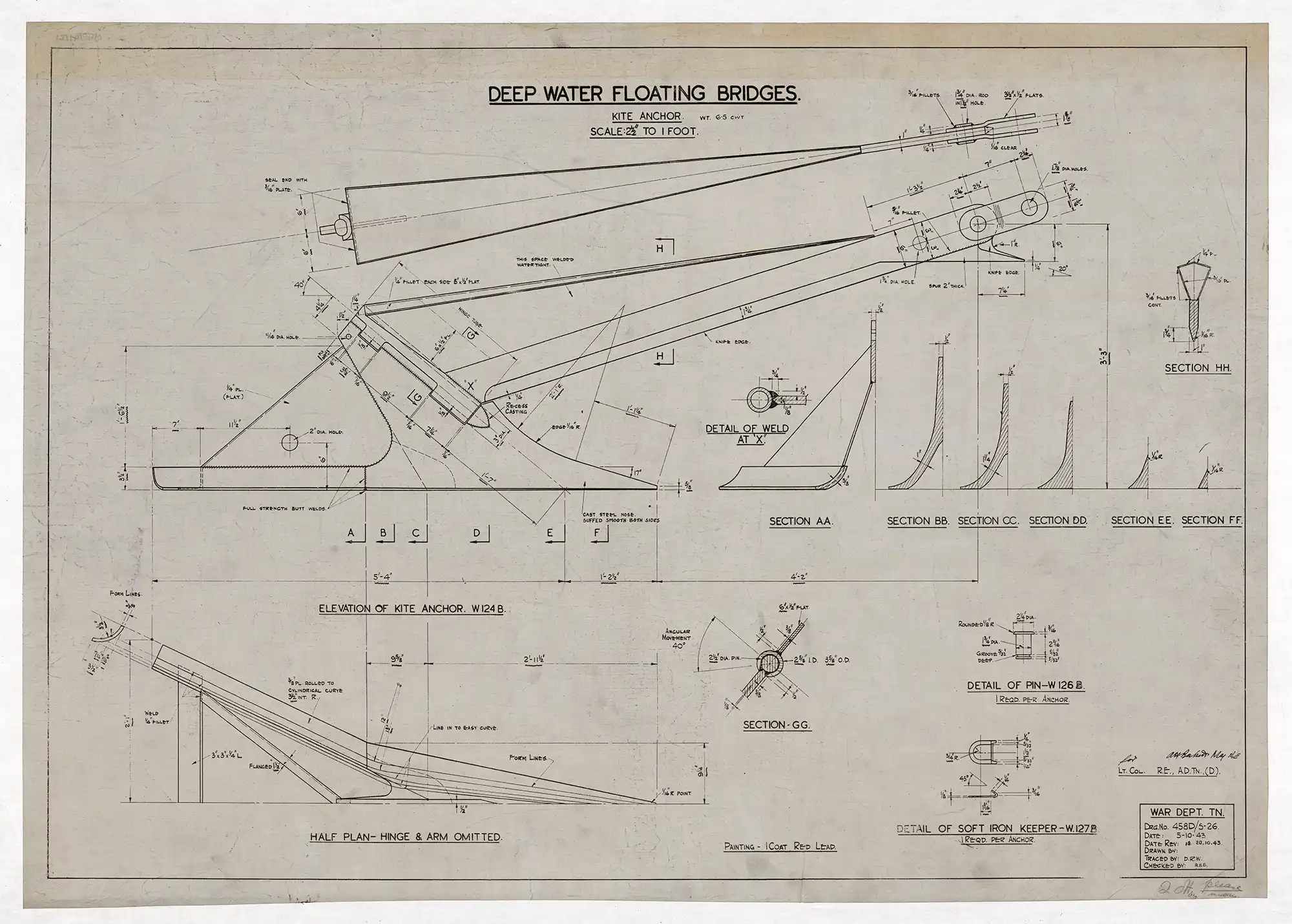
A plan of the kite anchor, drawn in 1943, one of the 605 plans of the Mulberry Harbour held by the Museum. REM MHP/41/21. Crown Copyright Open Government Licence 3.0
Two thousand, four hundred and thirty-four Kite Anchors are known to have been made over the course of the war, with the intention of using two per Beetle pontoon. The Americans at Mulberry A only used a single anchor every other pontoon, a factor that contributed to the destruction of the American port in the storm that started on D+13.
The Admiralty had been considering using concrete clumps weighing two or three tons to keep the port in place, but during trials in Scotland in early 1943 these proved insufficient, allowing too much movement. For the Whale roadway to be usable in all conditions, the Beetles had to be kept within six inches (15cm) of their moorings. Allan Beckett’s Kite Anchor did this job successfully.
Despite the Anchor’s production drawing only being finalised on 5th October 1943, by 31st March 1944 there were already 1240 Kite Anchors ready for use. Small models of the anchor were tested in St James Park before full scale production commenced.
Beehive Charges and Rock Anchors
The Kite Anchor worked on soft ground with harder ground underneath. However, on rocky patches on the Normandy coastline a Kite Anchor could not be used. Here, Beehive Charges and Self-Grouting Rock Anchors were used instead.

The Beehive charge, from Beehive Description of Method and Use, 1942. REM 8803.4.9. Crown Copyright Open Government Licence 3.0
The Beehive Charge was a small explosive charge that used 7lbs (3kg) of the explosive Pentolite to blast holes into the rocky floor. The charge itself had a diameter of six inches, was seven inches long (15cm x 18cm) and was stored in a cone-shaped casing with three legs to rest on. These legs ensured the best results, as the Beehive Charge was designed to be detonated 4 ½ inches (11cm) away from the surface of the rock. The three legs were exactly this length, so the charge could be placed and detonated without additional preparations. The detonation left behind a hole six inches wide (15cm) and up to three feet deep (1m) in soft rock, but only one foot three inches (38cm) in hard rock. Detonating another charge into the same hole could increase the depth by up to one foot (30cm).
